Doctor
The Box ManDoctor, also referred to as the Army Medical Captain, is a trained physician whose name and identity are used by a former medical corpsman to continue practicing medicine. His decline—from wartime research and medical work to addiction, isolation, and disappearance—makes him both the origin of the impostor’s borrowed authority and a person whose illness complicates the narrator’s account of his own illegal practice.
Identity and Wartime Work
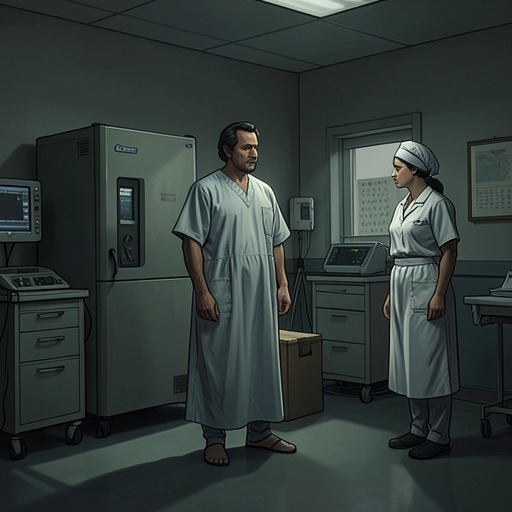
The affidavit identifies Doctor as the Army Medical Captain whose identity the narrator borrowed. The two met in a field hospital during the war, where the narrator served as Doctor’s orderly. Doctor was then absorbed in research into making sugar from wood, a project prompted by wartime scarcity. He conjectured that goats’ intestines contained an enzyme that could convert cellulose in paper, whose raw material was wood, into starch, and devoted himself to separating and extracting it.
Doctor also supervised the narrator’s medical training. Under his guidance, the orderly performed increasingly complicated operations and took over a substantial share of patient examinations and treatment while Doctor concentrated on research. The narrator later claimed to have developed considerable surgical skill, but the account distinguishes that acquired ability from Doctor’s status as the physician whose identity and qualifications made the clinic appear legitimate.
Addiction and the Clinic
The narrator’s account says that, after Doctor repeatedly pleaded for drugs, he began administering them daily. By the end of the war, Doctor showed signs of addiction. The two were demobilized together, and afterward they worked side by side to open a clinic. Doctor’s condition did not improve: he became personally unable to examine or treat patients and gave instructions through medical charts instead.
The narrator presents his continued supply of drugs as an act of friendship rather than obedience or coercion, while also acknowledging that it prolonged Doctor’s addiction and amounted to euthanasia over time. He says that treating Doctor was exceptionally difficult and that he lacked the courage to abandon him. This explanation places care and harm together: the narrator describes himself as trying to sustain a sick companion, but his daily administration of drugs also forms part of the circumstances of Doctor’s decline.
Borrowed Identity and Withdrawal from Public Life
For a time, Doctor handled external contacts, including attendance at medical meetings, while the narrator managed much of the clinical work. In what the affidavit calls the eighth year of Doctor’s practice, Doctor’s speech and conduct became conspicuously abnormal. Abuse and defamatory remarks about him, including suggestions that he was mad, reached the clinic. The pair were also being investigated because of their excessive drug use. After discussing the situation, they closed the clinic and moved to another city.
Doctor’s mental state worsened, and his weariness with life and inclination toward suicide became increasingly pronounced. At Nana’s suggestion, the pair stopped having him appear in public, even at outside events, and the narrator registered himself as Doctor. According to the affidavit, Doctor fully agreed to the arrangement, and the formal setup changed while the practical division of work remained much the same. The narrator says that patients continued to trust him in the new city; that trust, however, did not give him legal authority to practice under another man’s identity.
Relationships and Strain
Nana was Doctor’s legal wife and had managed the clinic’s accounts. The narrator says that he and Nana later became intimate and lived together as common-law partners, with Doctor’s knowledge and approval. He also recounts Doctor’s fear that the narrator would leave: Doctor allegedly pressured Nana to form a relationship with him as a way to keep the narrator at the clinic. These details make the household part of the same precarious arrangement as the medical practice, bound together by dependency, illness, and the narrator’s borrowed professional identity.
When the narrator hired Toyama Yoko as an apprentice nurse, Nana objected and proposed that she and the narrator live apart. He agreed. The narrator also says that Doctor’s demands concerning Toyama Yoko’s privacy and care caused him considerable concern. He describes feeling no lasting bitterness toward Doctor, arguing that illness brings suffering that healthy people may not understand and that the sick should be treated with sympathy. His account thus presents Doctor as both a source of pressure and a person whose condition calls for compassion.
Disappearance and the Unidentified Corpse
The affidavit eventually identifies the body at issue as Doctor’s, while stating that the cause of death is unknown. The narrator calls him the Army Medical Captain not to emphasize his former rank but because that title had become habitual after years of use. He expresses regret that he failed to prevent Doctor’s apparent suicide, but the affidavit does not establish how Doctor died; his long-standing suicidal inclination is reported as context, not proof of the cause.
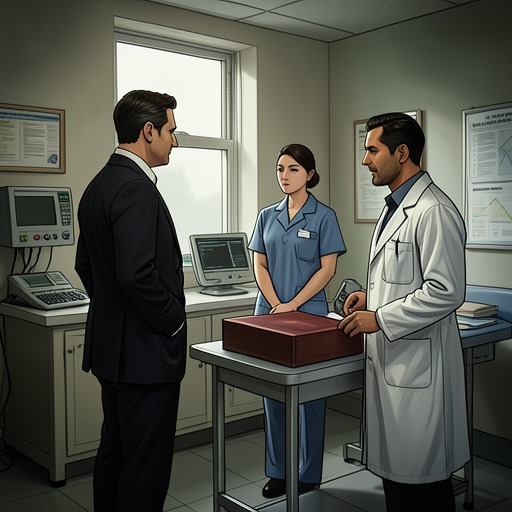
The narrator also explains why Doctor’s disappearance was not immediately reported. He and the nurse had promised not to enter Doctor’s room unless he rang for them, and, according to the account, more than half a day could pass without a summons. They became suspicious late on Sunday night and checked the room. The narrator says he was prepared to request a police search if Doctor had not returned by dawn, even though doing so risked exposing his illegal practice. Separate testimony about a box man entering and leaving the hospital, together with the marks left by shots over time, brought the narrator under suspicion in connection with the corpse.
Doctor’s role is therefore inseparable from the affidavit’s competing claims of loyalty and responsibility. The narrator admits that he practiced illegally and eventually resolves to confess, but he also presents that practice as a way of continuing care for a man who had once trained him and who, in his account, no longer needed him. The identification of the corpse gives Doctor’s disappearance a grave consequence without resolving its circumstances, leaving the narrator’s testimony to carry both the explanation of the borrowed identity and the uncertainty surrounding Doctor’s death.